
Door Closer Guide for Mr. Locks: Types, Uses, and Installation Insight
In the architectural landscape of New York City, a door is rarely just an entryway. From the heavy glass portals of Midtown skyscrapers to the fire-rated entry doors of Brooklyn brownstones, every opening serves a specific functional, legal, and safety purpose. At the heart of this functionality lies the door closer.
While often overlooked, a door closer is a critical component of a building’s life-safety system. A properly chosen and adjusted closer keeps doors from slamming, helps contain fire and smoke, maintains security, and ensures that everyone – regardless of physical ability – can navigate a space safely. For property managers, co-op boards, and business owners in NYC, understanding door closers is not just about maintenance; it is about compliance and liability management.
This comprehensive guide explores the mechanics, varieties, and regulatory requirements of door closers, providing the insight needed to manage these essential hardware components effectively.
1. What Is a Door Closer and Why Does It Matter?
A door closer is a mechanical or electro-mechanical device that automatically closes a door after it has been opened, controlling both the speed and the force of the closure. While the concept is simple, the engineering involves a precise balance of spring tension and hydraulic resistance.
The Mechanics of Control
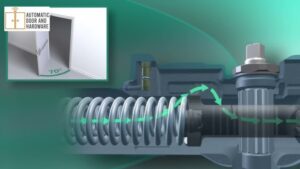
Most modern door closers utilize a high-tension spring to store the energy generated when a person opens the door. As the person lets go, the spring releases that energy to pull the door shut. To prevent the door from simply snapping shut (which would cause injury and damage), the device uses a hydraulic damper – a chamber filled with oil – to regulate the speed of the return.
Why They Are Essential in NYC
In the context of New York City’s high-density environment, door closers provide four primary benefits:
- Life Safety and Fire Containment: In the event of a fire, a door that remains open allows oxygen to feed the flames and smoke to travel through corridors. A self-closing door is a primary defense in “compartmentation,” the strategy of confining fire to its point of origin.
- Building Security: A lock is only effective if the door is closed. Closers ensure that after a resident or employee enters, the door returns to a latched and locked position without requiring manual intervention.
- Physical Protection: NYC wind tunnels and heavy foot traffic can cause doors to slam with immense force. Closers protect the door frame, the glass, and the hardware from the structural fatigue caused by repeated slamming.
- Energy Efficiency and Comfort: By ensuring doors aren’t left ajar, closers help maintain the “stack effect” in tall buildings and prevent the loss of conditioned air, lowering utility costs for property owners.
2. Manual vs. Automatic Door Closers
When selecting hardware, the first decision is the mode of operation.
Manual Door Closers
Manual closers are the industry standard. They rely entirely on the physical force exerted by the user to “charge” the spring.
- Best For: Apartment entry doors, stairwell doors, and standard office interiors.
- Advantage: Reliability and low maintenance. Without electrical components, they operate during power outages and require minimal intervention once correctly adjusted.
Automatic (Low-Energy) Operators
Automatic door closers, often referred to as low-energy operators, incorporate a motor. They can be triggered by a “Push to Open” button, a motion sensor, or an access control system.
- Best For: Main building entrances, healthcare facilities, and any opening that must meet strict ADA (Americans with Disabilities Act) accessibility standards.
- Advantage: They remove the physical barrier of a heavy door for individuals with mobility impairments, elderly residents, or parents with strollers.
Mr. Locks specializes in both systems, ensuring that manual closers meet the opening force requirements of the ADA while providing high-tech automatic solutions for modern commercial spaces.
3. Common Types of Door Closers in NYC Buildings
New York’s diverse building stock – ranging from pre-war landmarks to ultra-modern glass towers – requires a wide variety of hardware configurations.
Surface-Mounted Door Closers
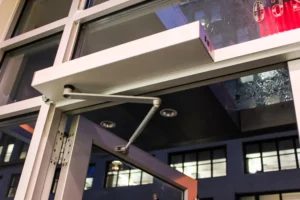
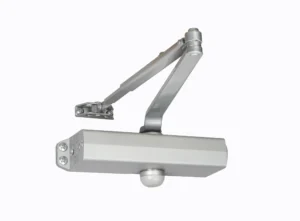
This is the most visible and common type of closer. The body of the device is mounted to the face of the door or the frame header.
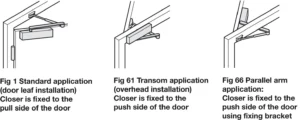
- Configurations: * Regular Arm: The closer is on the pull side of the door.
- Parallel Arm: The closer is on the push side, and the arm folds parallel to the door when closed. This is preferred for aesthetics and to prevent vandalism.
- Top Jamb: The closer body is mounted on the frame header, common for aluminum storefront doors.
- Application: Standard commercial doors, retail entrances, and office corridors.
Overhead Concealed Door Closers
For high-end residential lobbies and modern storefronts, the “industrial” look of a surface-mounted closer may be undesirable. Overhead concealed closers are hidden within the frame header or the top rail of the door.
- Aesthetics: Only a small portion of the arm is visible when the door is open.
- Durability: Because the unit is protected within the door or frame, it is shielded from the elements and tampering.
Floor-Mounted Door Closers (Floor Checks)
Floor closers are heavy-duty units installed in a cement case beneath the floor surface. The door sits on a pivot that is directly connected to the closer mechanism.
- High Traffic: These are designed for the heaviest doors, such as the massive glass or bronze doors found in NYC apartment lobbies and corporate headquarters.
- Double-Acting: Many floor closers allow the door to swing in both directions and return to a precise center point.
Concealed and Spring Hinge Closers
For lighter-duty needs, such as utility closets or residential interior doors:
- Concealed Jamb Closers: These are hidden in the hinge-side of the door frame.
- Spring Hinges: These look like standard hinges but contain an internal spring. While they provide self-closing action, they offer less control over the “latch” and “sweep” speeds compared to hydraulic units.
Storm and Screen Door Closers
In residential NYC settings, lightweight pneumatic tube closers are common for screen doors. These are easily adjustable for homeowners but are not suitable for fire-rated or commercial applications.
4. Technical Insight: Key Features and Adjustments
A door closer is not a “set it and forget it” device. To function correctly, four specific hydraulic valves must be balanced by a technician.
1. Closing (Sweep) Speed
This controls how fast the door moves from a 90-degree open position down to about 10 or 15 degrees. If the sweep is too fast, the door becomes a safety hazard; if too slow, it disrupts traffic flow and lets in drafts.
2. Latch Speed
This governs the final 10 degrees of closing. The goal of the latch speed is to provide just enough force to engage the latch bolt into the strike plate without slamming the door. In NYC, where building pressure (the stack effect) can be high, the latch speed often needs to be increased to overcome the air resistance of a sealed building.
3. Backcheck (BC)
Backcheck is the “shock absorber” for the opening cycle. It provides resistance when the door is opened past 70 degrees. This prevents a gust of wind or a forceful push from slamming the door against the wall or overextending the hinges.
4. Delayed Action (DA)
Often used in nursing homes or retail spaces, delayed action holds the door open at a wide angle for a pre-set amount of time before beginning the closing cycle. This allows extra time for someone in a wheelchair or someone carrying packages to pass through safely.
5. Door Closers and NYC Fire Code Compliance
In New York City, compliance isn’t just a suggestion – it’s a legal mandate. The NYC Self-Closing Door Law (Local Law 111 of 2018) and subsequent updates have placed immense responsibility on property owners.
The Self-Closing Mandate
All apartment entry doors in multi-unit buildings must be self-closing. This means that if a resident flees their apartment during a fire, the door must automatically close behind them to prevent smoke from filling the public hallways and stairwells.
Common Violations
Inspectors from the HPD (Housing Preservation & Development) and FDNY frequently issue violations for:
- Disabled Closers: Residents often disconnect arms to move furniture and forget to reconnect them.
- Paint Clogging: Painters often spray over closer arms and joints, causing them to seize.
- Improper Adjustment: A door that closes but fails to “click” into the latch is not considered closed by NYC code.
Fire Ratings
Closers used on fire-rated doors must be UL-listed and tested to maintain the integrity of the fire assembly. Mr. Locks ensures that all hardware installed on egress paths meets these stringent certifications.
6. When to Repair, Adjust, or Replace
How do you know when your door closer has reached the end of its life?
Signs You Need an Adjustment
- The door is slamming loudly.
- The door is staying open a few inches and not latching.
- The door is very difficult to pull open.
- The door closes too slowly, allowing unauthorized people to “tailgate” into the building.
Signs You Need a Full Replacement
- Fluid Leaks: If you see dark oil dripping down the door or pooling on the floor, the internal seals are blown. Since these units are pressurized and sealed at the factory, they cannot be refilled.
- Mechanical Failure: If the door has no resistance when opening or “flops” shut, the internal spring is likely broken.
- Stripped Valves: If turning the adjustment screws has no effect on the speed, the internal hydraulic bypass is damaged.
7. Why Professional Service Beats DIY
While it may be tempting to have a general building handyman “tighten the screws,” door closer installation is a specialized trade.
Sizing and Power
Closers are rated by “size” (usually 1 through 6). A size 1 is for light interior doors; a size 6 is for heavy exterior doors in high-wind areas. Installing an undersized closer leads to premature failure, while an oversized closer makes the door nearly impossible for a child or senior to open.
The “Stack Effect” Challenge
NYC skyscrapers act like giant chimneys. In the winter, cold air rushes in at the bottom and warm air rises, creating immense pressure on lobby doors. A professional locksmith understands how to select a “high-performance” closer that can overcome this pressure without violating ADA opening force limits (typically 5 lbs of force for interior doors).
Brand Excellence: Norton Door Closers
Mr. Locks frequently recommends Norton Door Closers. As part of the ASSA ABLOY group, Norton has been the industry leader in the US since 1880. Their products, such as the 7500 Series, are designed for high-abuse environments like New York schools, hospitals, and subway-adjacent commercial spaces.
8. How Mr. Locks Supports NYC Property Owners
Mr. Locks is more than just a locksmith; we are partners in building safety. Our services for NYC property owners include:
- Comprehensive Site Surveys: We inspect every door on your egress path to ensure they meet the latest NYC fire and accessibility codes.
- Emergency Repairs: If a lobby door closer fails on a Friday night, your building is no longer secure. We offer rapid-response repair services across all five boroughs.
- Custom Retrofitting: We can replace outdated, leaking floor closers with modern surface-mounted units or concealed overhead solutions that fit the existing architecture.
- ADA Upgrades: We help building owners transition from manual doors to automatic operators, ensuring full compliance with the Americans with Disabilities Act.
Conclusion
A door closer is a small piece of hardware that carries a massive responsibility. In New York City, where the safety of thousands of residents depends on the integrity of fire-rated openings, you cannot afford to overlook your door closers.
From protecting your investment in high-end door hardware to avoiding costly FDNY violations, the right closer makes all the difference. Whether you are dealing with a slamming door in a Chelsea boutique or a non-latching fire door in a Bronx apartment complex, professional expertise is the only way to ensure lasting performance.
For expert door closer installation, repair, and code-compliance consulting in New York City, contact Mr. Locks today. We bring decades of experience to every opening, ensuring your building stays safe, secure, and accessible.
References and Further Reading
- NYC Building Code Chapter 10: Egress and Self-Closing Doors.
- ADA Standards for Accessible Design (Section 404): Opening Force and Closing Speed.
- ANSI/BHMA A156.4: Standards for Door Controls – Closers.
- Norton Rixson Technical Catalog: Understanding Hydraulic Damping.
Call us at 212-780-0144 or schedule a free estimate online to get started.